-

- Trade Leads
- Trade Services
- B2B Directories
- Trade Connections
- Misc
- Contact Us




A free import export trade leads B2B marketplace since 1996 for manufacturers, suppliers, exporters, importers, buyers, sellers, wholesalers, freight forwarders, shippers, trade shows, exhibits, and export management.
Hello visitor from USA - 51 visiting now from 39 USA
  5 China
  2 Germany
  2 India
  1 Netherlands
  1 Singapore
  1 Canada
Hello visitor from
USA - 51 visiting now from 39 USA 5 China 2 Germany 2 India 1 Netherlands 1 Singapore 1 Canada
Arc Welding Robot
Posted at: Offers to Sell and Export | Posted on: Tuesday 29 September 2026 7:20 am | Poster last visit: Tuesday 29 September 2026 |
Product Category: Main
» Industrial Manufacturing and Processing Machinery and Accessories
» Welding and soldering and brazing machinery and accessories and supplies
» Welding machinery
» Shielded metal arc welding or stick welding machine
» Arc Welding Robot
Product Description:
Arc Welding Robot
Overview
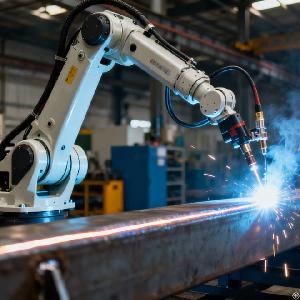
Arc welding robots, through automatic operation, not only significantly
boost welding efficiency but also ensure stable welding quality via standardized processes. Widely used in automobile manufacturing, construction machinery, pressure vessels, and other fields.
Key Advantages
Stable Quality: With repeat positioning accuracy up to ±0.05mm, arc welding automation ensures key parameters (current, voltage, speed) remain constant. This eliminates welding quality fluctuations caused by human fatigue or inexperience, guaranteeing uniform arc welds for arc welding robot operation.
Improved efficiency: Arc welding robots can work continuously for 24 hours a day, and the welding speed is 3-5 times faster than manual welding, greatly shortening the production cycle.
Cost Savings: Arc welding automation reduces long-term labor training and management costs. Additionally, it precisely controls consumable consumption (e.g., welding wire), further cutting material expenses for businesses.
Environmental safety: Arc welding robots replace manual work in harsh environments such as high temperature, high arc light, and spatter, reducing the risk of personnel exposure to dangerous environments.
System Composition
Arc welding robots typically consist of a robotic arm, a control system, a welding system, and a sensing system.
The robotic arm is the core of the arc welding robot system, generally composed of a mechanical structure, an electrical control system, and control software. It primarily performs various welding actions during the arc welding process.
The control system coordinates the work of each module, controlling the robot's movement trajectory and welding parameters to ensure a stable arc welding process.
The welding system is the core execution unit for realizing arc welding, including the welding torch, welding power source, wire feed mechanism, and shielding gas supply device. It is mainly responsible for generating the welding arc, feeding the welding wire, and providing welding energy.
The sensing system mainly includes arc sensors, vision sensors, and force sensors, which can monitor the weld position in real time, adjust parameters to compensate for deviations, and improve welding adaptability.
Application Industries
Automotive Manufacturing: The primary application area for arc welding robots, suitable for automated welding of components such as car body frames, side panels, and doors, meeting their high-volume and high-quality production needs.
Construction Machinery Industry: Used for welding structural components of equipment such as excavators, cranes, and loaders, capable of handling the welding of thick plates and large workpieces, ensuring structural strength and improving efficiency.
Pressure Vessel Industry: Used for welding storage tanks, pipelines, etc., ensuring the sealing and strength of welds, meeting safety standards such as high pressure and corrosion resistance.
Rail Transit Industry: Used for welding subway cars and high-speed rail bodies (especially aluminum alloy materials), controlling welding to prevent deformation and ensuring car body precision.
General Machinery Industry: Used for welding machine tools, motors, pumps, valves, etc., flexibly adaptable to multi-variety, small-to-medium batch production tasks.
Company Contact:

Contact Name: Comax Intelligent Technology Co., Ltd.
Company Name: Robot Automation
Email:
Tel: 15942306908
Fax:
Street Address: Guoxietang
Industrial Park, Shijiazhuang
High-tech
Shijiazhuang, Hebei 050035
China
Website: https://www.comaxrobots.com/
Member name: comaxrobots
Country: China
Member Since: 29 September 2026
Total Leads: 4 comaxrobots Import Export Business Leads
Business focus: Welding Robots, Material Handling Robots
Verify: Safe Import Export Tips

Overview
Arc welding robots, through automatic operation, not only significantly
boost welding efficiency but also ensure stable welding quality via standardized processes. Widely used in automobile manufacturing, construction machinery, pressure vessels, and other fields.
Key Advantages
Stable Quality: With repeat positioning accuracy up to ±0.05mm, arc welding automation ensures key parameters (current, voltage, speed) remain constant. This eliminates welding quality fluctuations caused by human fatigue or inexperience, guaranteeing uniform arc welds for arc welding robot operation.
Improved efficiency: Arc welding robots can work continuously for 24 hours a day, and the welding speed is 3-5 times faster than manual welding, greatly shortening the production cycle.
Cost Savings: Arc welding automation reduces long-term labor training and management costs. Additionally, it precisely controls consumable consumption (e.g., welding wire), further cutting material expenses for businesses.
Environmental safety: Arc welding robots replace manual work in harsh environments such as high temperature, high arc light, and spatter, reducing the risk of personnel exposure to dangerous environments.
System Composition
Arc welding robots typically consist of a robotic arm, a control system, a welding system, and a sensing system.
The robotic arm is the core of the arc welding robot system, generally composed of a mechanical structure, an electrical control system, and control software. It primarily performs various welding actions during the arc welding process.
The control system coordinates the work of each module, controlling the robot's movement trajectory and welding parameters to ensure a stable arc welding process.
The welding system is the core execution unit for realizing arc welding, including the welding torch, welding power source, wire feed mechanism, and shielding gas supply device. It is mainly responsible for generating the welding arc, feeding the welding wire, and providing welding energy.
The sensing system mainly includes arc sensors, vision sensors, and force sensors, which can monitor the weld position in real time, adjust parameters to compensate for deviations, and improve welding adaptability.
Application Industries
Automotive Manufacturing: The primary application area for arc welding robots, suitable for automated welding of components such as car body frames, side panels, and doors, meeting their high-volume and high-quality production needs.
Construction Machinery Industry: Used for welding structural components of equipment such as excavators, cranes, and loaders, capable of handling the welding of thick plates and large workpieces, ensuring structural strength and improving efficiency.
Pressure Vessel Industry: Used for welding storage tanks, pipelines, etc., ensuring the sealing and strength of welds, meeting safety standards such as high pressure and corrosion resistance.
Rail Transit Industry: Used for welding subway cars and high-speed rail bodies (especially aluminum alloy materials), controlling welding to prevent deformation and ensuring car body precision.
General Machinery Industry: Used for welding machine tools, motors, pumps, valves, etc., flexibly adaptable to multi-variety, small-to-medium batch production tasks.
Company Contact:
Contact Name: Comax Intelligent Technology Co., Ltd.
Company Name: Robot Automation
Email:
Tel: 15942306908
Fax:
Street Address: Guoxietang
Industrial Park, Shijiazhuang
High-tech
Shijiazhuang, Hebei 050035
China
Website: https://www.comaxrobots.com/
Member name: comaxrobots
Country:
ChinaMember Since: 29 September 2026
Total Leads: 4 comaxrobots Import Export Business Leads
Business focus: Welding Robots, Material Handling Robots
Verify: Safe Import Export Tips
 Similar Suppliers And Manufacturers Import Export Trade Leads
 Laser Welding Robot - By comaxrobots - On Tuesday 29 September 2026 7:18 am: welding robot
leading laser welding robot manufacturer for high-precision automation
comax is a automatic welding robot manufacturer in china pro....
Laser Welding Robot - By comaxrobots - On Tuesday 29 September 2026 7:18 am: welding robot
leading laser welding robot manufacturer for high-precision automation
comax is a automatic welding robot manufacturer in china pro.... Spot Welding Robot - By comaxrobots - On Tuesday 29 September 2026 7:19 am: welding robot
spot welding robots are equipment that enables automated resistance spot welding they are equipped with welding guns fixtures etc t....
Spot Welding Robot - By comaxrobots - On Tuesday 29 September 2026 7:19 am: welding robot
spot welding robots are equipment that enables automated resistance spot welding they are equipped with welding guns fixtures etc t.... Alpha Arc 250 Welding Machine - By chinaweldingmachines - On Wednesday 22 July 2026 12:43 am: arc start and arc force adjustable
vrd to ensure operation safety
internal anti-stick to ensure stable welding
cellulose electrode applicable
....
Alpha Arc 250 Welding Machine - By chinaweldingmachines - On Wednesday 22 July 2026 12:43 am: arc start and arc force adjustable
vrd to ensure operation safety
internal anti-stick to ensure stable welding
cellulose electrode applicable
.... Nd Yag Pulsed Flash Lamp Power Supply For Mold Repair Welding / Jewelry Repair / Bettery Welding - By LASERPOWERSOURCE - On Saturday 27 December 2025 2:31 am: welding power supply
type 400w
technical specifications
model ico-pf-400wa
input voltage 380+20%v ac
charging voltage 500v dc
discharge powe....
Nd Yag Pulsed Flash Lamp Power Supply For Mold Repair Welding / Jewelry Repair / Bettery Welding - By LASERPOWERSOURCE - On Saturday 27 December 2025 2:31 am: welding power supply
type 400w
technical specifications
model ico-pf-400wa
input voltage 380+20%v ac
charging voltage 500v dc
discharge powe.... Pv Trackless Cleaning Robot - By trinarobot - On Tuesday 5 August 2025 2:20 am: robot is a cutting-edge solution designed for commercial and industrial c amp amp i rooftop photovoltaic pv systems this autonomous solar panel c....
 Pv Railed Cleaning Robot - By trinarobot - On Tuesday 5 August 2025 2:19 am: pv railed cleaning robot
fast deployment
self-powered by the module no need to deploy charging cables
environmental perception
automatic cleaning task based on the meteo....
Pv Railed Cleaning Robot - By trinarobot - On Tuesday 5 August 2025 2:19 am: pv railed cleaning robot
fast deployment
self-powered by the module no need to deploy charging cables
environmental perception
automatic cleaning task based on the meteo.... Arc Line Stone - By softstonemaster - On Thursday 11 June 2026 3:03 am: arc line soft stone is a high-end architectural stone known for its clean linear textures and elegant surface structure with its distinctive arc-shap....
 Auxiliary Module Installation Robot - By trinarobot - On Tuesday 5 August 2025 2:18 am: robotics such as the trinabot photovoltaic panel installation robot are transforming the renewable energy sector these advanced systems install sol....
 Shielded metal arc welding or stick welding machine Classification Navigation
Main - Industrial Manufacturing and Processing Machinery and Accessories - Welding and soldering and brazing machinery and accessories and supplies - Welding machinery - Shielded metal arc welding or stick welding machine [37]
TradersCity.com shall not be held liable for any user posted/submitted content including but not limited to trade leads, profiles, images, and any other data. TradersCity.com does not and did not verify any of users posted/submitted data nor is implicitly or explicitly recommending these business offers. TradersCity does not verify truthfulness, accuracy, completeness, nor legality of any businesses, services, and leads posted here. TradersCity does not represent Sellers or Buyers in any transaction between users of the website and is unable to make any opinion in regard to their performance in any transaction. TradersCity neither guarantees nor undertakes in any dispute between sellers and buyers. Protect your business from fraud by trading safely