-

- Trade Leads
- Trade Services
- B2B Directories
- Trade Connections
- Misc
- Contact Us




A free import export trade leads B2B marketplace since 1996 for manufacturers, suppliers, exporters, importers, buyers, sellers, wholesalers, freight forwarders, shippers, trade shows, exhibits, and export management.
Hello visitor from USA - 169 visiting now from 67 USA
  66 Belgium
  32 China
  2 India
  1 Singapore
  1 Russia
Hello visitor from
USA - 169 visiting now from 67 USA 66 Belgium 32 China 2 India 1 Singapore 1 Russia
Frp Wind Pipe
Posted at: Offers to Sell and Export | Posted on: Friday 20 March 2026 6:48 am | Poster last visit: Friday 20 March 2026 |
Product Category: Main
» Distribution and Conditioning Systems and Equipment and Components
» Heating and ventilation and air circulation
» Ventilation
» Ventilation pipes
» Frp Wind Pipe
Product Description:
Our company can produce various specifications of glass fiber reinforced plastic quartz sand-filled winding
pipes with a diameter of 4000mm and a length of less than 12000mm, as well as various process pipes with a diameter of less than 300mm. The entire winding process is controlled by a microcomputer, with the characteristics of beautiful lines, high precision, and easy operation.
The working temperature of the pipeline is -40℃-80℃. The specially proportioned pipeline can withstand a high temperature of 110℃, and the pipeline will not crack under freezing media. If used for pipelines with large and medium flow rates, the engineering cost of large-diameter quartz sand-filled pipelines is 30% lower than that of steel pipes of the same diameter, which is equivalent to cement pipes. It is also convenient to transport, has low construction costs, does not require maintenance, and has a service life of more than 50 years.
Features of FRP pipes:
Chemical corrosion resistance, long service life
FRP has special chemical corrosion resistance, and its pipe products are suitable for conveying various media such as acids, alkalis, salts and organic solvents
Excellent physical and mechanical properties
The specific gravity of FRP pipe materials is usually 1.8-2.1g/cm', which is about 1/4-1/5 of steel, and has higher specific strength than steel, cast iron and plastic.
The weight of FRP pipes is generally no more than 1/3 of the same specification steel pipes, and the physical and mechanical properties are excellent. In addition, some physical properties of FRP pipes are also quite superior. The thermal expansion coefficient is roughly equivalent to that of steel, and the thermal conductivity coefficient is only 0.5% of that of steel. It is a good thermal and electrical insulator.
Excellent hydraulic properties
Hydraulic properties are one of the main properties of FRP pipes. Excellent hydraulic properties mean that the fluid pressure head loss is small, and a smaller diameter or a smaller power delivery pump can be selected, thereby reducing the initial investment of pipeline projects, saving electricity, and reducing operating costs.
The inner surface of the FRP pipe is quite smooth, and the general surface roughness can be taken as 0.008, which can almost be considered as a "hydraulic smooth pipe". During operation, the inner surface of steel pipes, cast iron pipes, cement pipes, etc. often undergo local corrosion and become more and more rough, while the FRP pipe always maintains the surface smooth state of the new pipe.
High design flexibility and short modification cycle
The FRP pipe is formed by winding the fiber-reinforced material impregnated with a resin matrix layer by layer onto the core mold according to specific process conditions and properly curing it. The pipe wall is a layered structure. The physical and chemical properties of the FRP pipe can be adjusted by changing the resin system or using different reinforcing materials to adapt to different media and working conditions to make FRP pipes with different pressure levels or certain special properties. The short modification cycle is a significant feature of fiber-wound composite materials, which cannot be compared with various homogeneous metal pipes.
Low installation and maintenance costs
GRP pipes do not require special anti-corrosion treatment, the insulation layer can be thinned, or even no insulation treatment is done, the pipes are relatively light, the lifting equipment has a small tonnage, and the power consumption is low. The length of the GRP pipe is longer than that of cast iron and cement pipes, and the number of joints is relatively reduced. These will reduce installation and maintenance costs, which has been proven by many engineering practices at home and abroad.
Wide application areas
·Chemical medium delivery pipes;
·Press water pipes of small hydropower stations on the ground, circulating water pipes of power plants;
·Sewage collection and delivery pipelines;
·Drinking water delivery trunk pipes and distribution pipes
·Oil field injection pipes and crude oil delivery pipes:
"Heat energy delivery pipes, seawater delivery pipes:
·Agricultural irrigation pipes;
Glass fiber reinforced plastic devices (ventilation and air conditioning, chimneys, scrubbers, etc.) and their piping;
·Various process pipes (chemical process, papermaking process, sewage treatment process, seawater desalination process, food and beverage processing, pharmaceutical process, etc.).
Glass fiber reinforced plastic sand-filled pipe
Glass fiber reinforced plastic sand-filled pipe is the result of many years of scientific research and development and successful manufacturing. It is a new material used in large-scale fluid transportation projects after prestressed concrete pipes, ductile iron pipes, and cast iron pipes. It is mainly used for buried pipes and overhead pipes. It has light weight, high strength, corrosion resistance, long service life, low operation and maintenance costs, and can save a lot of money for construction projects.
The main molding process is controlled by a computer. The lining is made on the core mold according to the prescribed procedure (the same as the fiber winding glass fiber reinforced plastic pipe lining production process). After gelling, the structural layer is wound according to the designed linear shape and thickness, and the mortar mixed with quartz sand and resin is wound in the structural layer, and finally the outer protective layer is wound.
Company Contact:

Contact Name: Tong
Company Name: Hebei Runlin Environmental Protection Technology Co., Ltd
Email:
Tel: 13373517291
Fax:
Street Address: Xingyuan South
Street, Zaoqiang County
Hengshui, Hebei 053100
China
Website: https://www.hbrunlinhb.com/
Member name: hbrunlinhb
Country: China
Member Since: 20 March 2026
Total Leads: 5 hbrunlinhb Import Export Business Leads
Business focus: Frp Wind Pipe, Custom Frp, Frp Pipe Fittings
Verify: Safe Import Export Tips
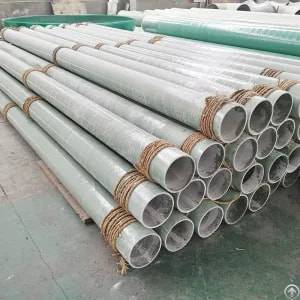

pipes with a diameter of 4000mm and a length of less than 12000mm, as well as various process pipes with a diameter of less than 300mm. The entire winding process is controlled by a microcomputer, with the characteristics of beautiful lines, high precision, and easy operation.
The working temperature of the pipeline is -40℃-80℃. The specially proportioned pipeline can withstand a high temperature of 110℃, and the pipeline will not crack under freezing media. If used for pipelines with large and medium flow rates, the engineering cost of large-diameter quartz sand-filled pipelines is 30% lower than that of steel pipes of the same diameter, which is equivalent to cement pipes. It is also convenient to transport, has low construction costs, does not require maintenance, and has a service life of more than 50 years.
Features of FRP pipes:
Chemical corrosion resistance, long service life
FRP has special chemical corrosion resistance, and its pipe products are suitable for conveying various media such as acids, alkalis, salts and organic solvents
Excellent physical and mechanical properties
The specific gravity of FRP pipe materials is usually 1.8-2.1g/cm', which is about 1/4-1/5 of steel, and has higher specific strength than steel, cast iron and plastic.
The weight of FRP pipes is generally no more than 1/3 of the same specification steel pipes, and the physical and mechanical properties are excellent. In addition, some physical properties of FRP pipes are also quite superior. The thermal expansion coefficient is roughly equivalent to that of steel, and the thermal conductivity coefficient is only 0.5% of that of steel. It is a good thermal and electrical insulator.
Excellent hydraulic properties
Hydraulic properties are one of the main properties of FRP pipes. Excellent hydraulic properties mean that the fluid pressure head loss is small, and a smaller diameter or a smaller power delivery pump can be selected, thereby reducing the initial investment of pipeline projects, saving electricity, and reducing operating costs.
The inner surface of the FRP pipe is quite smooth, and the general surface roughness can be taken as 0.008, which can almost be considered as a "hydraulic smooth pipe". During operation, the inner surface of steel pipes, cast iron pipes, cement pipes, etc. often undergo local corrosion and become more and more rough, while the FRP pipe always maintains the surface smooth state of the new pipe.
High design flexibility and short modification cycle
The FRP pipe is formed by winding the fiber-reinforced material impregnated with a resin matrix layer by layer onto the core mold according to specific process conditions and properly curing it. The pipe wall is a layered structure. The physical and chemical properties of the FRP pipe can be adjusted by changing the resin system or using different reinforcing materials to adapt to different media and working conditions to make FRP pipes with different pressure levels or certain special properties. The short modification cycle is a significant feature of fiber-wound composite materials, which cannot be compared with various homogeneous metal pipes.
Low installation and maintenance costs
GRP pipes do not require special anti-corrosion treatment, the insulation layer can be thinned, or even no insulation treatment is done, the pipes are relatively light, the lifting equipment has a small tonnage, and the power consumption is low. The length of the GRP pipe is longer than that of cast iron and cement pipes, and the number of joints is relatively reduced. These will reduce installation and maintenance costs, which has been proven by many engineering practices at home and abroad.
Wide application areas
·Chemical medium delivery pipes;
·Press water pipes of small hydropower stations on the ground, circulating water pipes of power plants;
·Sewage collection and delivery pipelines;
·Drinking water delivery trunk pipes and distribution pipes
·Oil field injection pipes and crude oil delivery pipes:
"Heat energy delivery pipes, seawater delivery pipes:
·Agricultural irrigation pipes;
Glass fiber reinforced plastic devices (ventilation and air conditioning, chimneys, scrubbers, etc.) and their piping;
·Various process pipes (chemical process, papermaking process, sewage treatment process, seawater desalination process, food and beverage processing, pharmaceutical process, etc.).
Glass fiber reinforced plastic sand-filled pipe
Glass fiber reinforced plastic sand-filled pipe is the result of many years of scientific research and development and successful manufacturing. It is a new material used in large-scale fluid transportation projects after prestressed concrete pipes, ductile iron pipes, and cast iron pipes. It is mainly used for buried pipes and overhead pipes. It has light weight, high strength, corrosion resistance, long service life, low operation and maintenance costs, and can save a lot of money for construction projects.
The main molding process is controlled by a computer. The lining is made on the core mold according to the prescribed procedure (the same as the fiber winding glass fiber reinforced plastic pipe lining production process). After gelling, the structural layer is wound according to the designed linear shape and thickness, and the mortar mixed with quartz sand and resin is wound in the structural layer, and finally the outer protective layer is wound.
Company Contact:
Contact Name: Tong
Company Name: Hebei Runlin Environmental Protection Technology Co., Ltd
Email:
Tel: 13373517291
Fax:
Street Address: Xingyuan South
Street, Zaoqiang County
Hengshui, Hebei 053100
China
Website: https://www.hbrunlinhb.com/
Member name: hbrunlinhb
Country:
ChinaMember Since: 20 March 2026
Total Leads: 5 hbrunlinhb Import Export Business Leads
Business focus: Frp Wind Pipe, Custom Frp, Frp Pipe Fittings
Verify: Safe Import Export Tips
 Similar Suppliers And Manufacturers Import Export Trade Leads
 Frp Pipe Fittings - By hbrunlinhb - On Friday 20 March 2026 6:49 am: frp fiberglass reinforced plastic pipe fittings are specialized components used in piping systems to connect alter or control the flow of fluids ....
 Floating Deep-wind Wind Power Offshore Mooring Chain - By ChinaShippingAnchorChain - On Thursday 27 June 2024 8:49 am: floating deep-wind wind power offshore mooring chain mooring chain 30mm 162mm anchor chain mooring chain mooring buoy system we have a big advantage over other factories in the price
anchor ac-14 a.... Fishery Industry Floating Deep-wind Wind Power Offshore Mooring Chain - By ChinaShippingAnchorChain - On Thursday 27 June 2024 9:31 am: wind wind power offshore mooring chain
1 high quality with competitive prices
2 much experience in producting and exporting
3 special design fo....
Floating Deep-wind Wind Power Offshore Mooring Chain - By ChinaShippingAnchorChain - On Thursday 27 June 2024 8:49 am: floating deep-wind wind power offshore mooring chain mooring chain 30mm 162mm anchor chain mooring chain mooring buoy system we have a big advantage over other factories in the price
anchor ac-14 a.... Fishery Industry Floating Deep-wind Wind Power Offshore Mooring Chain - By ChinaShippingAnchorChain - On Thursday 27 June 2024 9:31 am: wind wind power offshore mooring chain
1 high quality with competitive prices
2 much experience in producting and exporting
3 special design fo.... Wind And Solar Hybrid Power Generation System - By gxqianyun - On Sunday 27 April 2025 6:41 am: wind solar hybrid system offers the best of both worlds by combining wind and solar power this innovative system provides continuous energy generatio....
 Steel Wire Rope For Wind Power Generation - By suntaysteel - On Wednesday 18 June 2025 2:30 am: wind power generation is a high-performance produtc specially designed and manufactured for the safety lifting equipment in the fan tower-free climber.... Frp Products - By InnoIntegrationsInc - On Wednesday 23 July 2025 3:57 am: frp products are crafted using high-quality composite materials tailored to specific performance needs our skilled workers and technicians master di....
 Hot Sale Anchor Chain For Float Offshore Wind Power - By CSAC - On Sunday 7 April 2024 6:39 am: hot sale anchor chain for float offshore wind power
this is rachel from china shipping anchor chain jiangsu co ltd our factory is located in jiangsu province china
we mainly produce stud link a....
Hot Sale Anchor Chain For Float Offshore Wind Power - By CSAC - On Sunday 7 April 2024 6:39 am: hot sale anchor chain for float offshore wind power
this is rachel from china shipping anchor chain jiangsu co ltd our factory is located in jiangsu province china
we mainly produce stud link a.... Frp Septic Tank - By hbrunlinhb - On Friday 20 March 2026 6:50 am: frp septic tank refers to equipment made of synthetic resin as the matrix and glass fiber reinforced materials specially used for treating domestic se....
 Import Export Startup Stories
Share Your Story & Get Listed at StartImportExport.com- Qingdao Saint-kin Wind Turbine Co Ltd: Sianna Of Qingdao Saintkin Wind Turbine From China
- Cangzhou Jinxinlei Pipeline Co Ltd: Hongguang Zhao Of Cangzhou Jinxinlei Pipeline, A Manufacturer And Exporter Of Carbon Steel Pipes From China
- Baoji Hong Ya Da Nonferrous Metal Materails Co Ltd: Ms Carrolyn Of Baoji Hong Ya Da Nonferrous Metal Materials From China
- Zhejiang Leo Building Material Ltd: Leo Chen Of Zhejiang Leo Building Material From China
Ventilation pipes Classification Navigation
Main - Distribution and Conditioning Systems and Equipment and Components - Heating and ventilation and air circulation - Ventilation - Ventilation pipes [46]
TradersCity.com shall not be held liable for any user posted/submitted content including but not limited to trade leads, profiles, images, and any other data. TradersCity.com does not and did not verify any of users posted/submitted data nor is implicitly or explicitly recommending these business offers. TradersCity does not verify truthfulness, accuracy, completeness, nor legality of any businesses, services, and leads posted here. TradersCity does not represent Sellers or Buyers in any transaction between users of the website and is unable to make any opinion in regard to their performance in any transaction. TradersCity neither guarantees nor undertakes in any dispute between sellers and buyers. Protect your business from fraud by trading safely